blog entry
Notebooks
Permalink for NotebooksMy current process and experience with keeping a notebook.
I want to talk to you today about notebooks. Not "journaling" explicitly. There's too much baggage in that term. especially with all the systems people use. Bullet journaling for productivity, gratitude journaling to make you a better person, dream journaling to make an attempt at understanding yourself, the list goes on and on, and the anxiety around doing it "right" does too. What should I write? how should I write? if I don't feel like it, do I have to? All these questions get in the way of the core of what writing is actually for. I want to talk about that part of it, what I've been trying lately, and how it has been working.
First off, I've never been big on journals, diaries, or anything else of that nature. The pop culture conception of journaling, of writing down everything that happened during a given day, is boring and not useful to me. I liked the idea of keeping a journal, but I never stuck to it. I feel like that has probably been my psyche understanding that I needed something from writing, but it didn't really know what or how to get there. I'm still not completely convinced it will stick this time, but I've been writing a lot more in the last few weeks than I have in the last thirty years. That said, this isn't a promise of anything. No secret well of creativity, no imperviousness to distraction, no secret to lead a good life. This is simply the thought process I have been going through and the impressions I've gotten of it after a little over a month.
A Notebook Permalink to this heading
I have found, in my experiments, that digital tools just can't cut it for me. I need a physical pen and physical paper. Even a stylus on a touch screen isn't it. That's fine for drawing, where I am spoiled by the rapid undo gestures and the line smoothing, but for writing I need to be writing with a real pen and real paper. I've tried so many digital tools over the years. None of them worked like I wanted to. So, I did a lot of thinking and careful consideration of what I wanted and what I could reasonably commit to in terms of materials. I came up with this list of requirements for my own re-introduction to writing stuff down in a notebook.
- The notebook must be physical, with real paper.
- The notebook must have more than 48 pages.
- The notebook must be able to fit in a pocket in most of my clothes.
- I should be able to write in the notebook without a completely solid surface.
- The pen must be comfortable to use.
- I must have a way to physically bind the pen to the notebook so they travel together.
- I must be able to get the notebook out and ready to write in quickly and should be able to put it away just as quickly.
- The materials must be either refillable or cheap to replace
If I had to sum this list up, it would be that it is a practical list of must-haves. I'm a very pragmatic person, so my list is all about the experience rather than the look or how it makes me feel to see the notebook on my desk. This is the kind of list that I need to get writing again. So here's what I came up with:
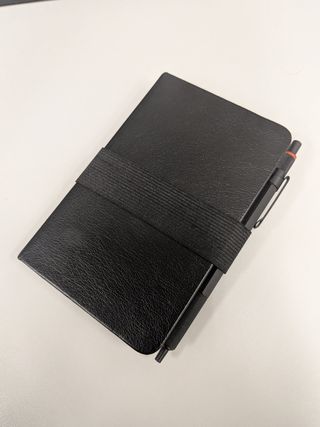
This is my notebook. The book itself is from Amazon. I did a lot of looking until my requirements were (mostly) met. I checked stationery and bookstores near me to see if I could manage to get something locally that would fit the bill and it just wasn't feasible. Even though I looked long and hard, this wasn't quite perfect, so I had to do a little customizing. I cut the ribbon bookmarks and existing elastic off of the book entirely. I didn't need or want the ribbons and the elastic was going the wrong direction. If I was going to use it to hold a pen to the book, I needed to make sure it wrapped around the package horizontally. I got a roll of elastic from a local craft store, measured and sewed my own loop. It's not affixed to the book in any way, but keeps it closed and holds the pen tight to the side exactly how I want.
The pen is a Rotring 600 in gel ink. It's a really nice, fully metal-bodied pen that takes Parker style refills. Notably not a pen I would replace unless it were to fully break or get lost. I haven't exhausted the ink that came with it yet, but when I run out, I think my pick is going to be the 0.5mm Kako G2 refills that I frustratingly cannot find anywhere but Amazon. They don't hold the most ink, but they write extremely nicely. They're the refills I would provide with the pens I made when I was doing more woodturning.
Writing Permalink to this heading
Many people have said over the centuries that writing is, in a very intense way, thinking. Writing is pulling thoughts, feelings, and ideas out of your brain so that they can be absorbed later. Whether by you or by some other person it doesn't really matter. The purpose of writing is to convey information. That is, importantly, not specifically to convey information to someone, but to move the information from one place to another. Getting something out of your head into a pit that it never needs to come out from is absolutely a reason to write something down. However, I have found that ideas that stick in my brain are probably worth considering, so when I write them down, I don't want to do so to get rid of them, but rather to allow my subconscious to work on them without my mind having to keep them in "active" thought just to prevent them from disappearing.
I have borrowed heavily from Perry Daniels's video on the subject, but it isn't a perfect copy 1-to-1 of his method. First of all, mine comes with no promises. Not even ones of more creativity. But it has worked for me. Before I get into my exact structure, though, I wanted to say a small piece on rules and systems in general.
If you are doing something, anything, for yourself, then you get to make the rules and decide if they need to be followed or not. Just because someone promises the moon with their "system" doesn't mean it will actually work that way for you. If you like the steps I've laid out below, then please follow them! If something doesn't fit, then abandon it! We get so caught up these days with worrying about if we're doing something correctly or not that often times we don't do it at all. The more you write, the easier it becomes to decide what to write and where to write it. So, here we go: my rules.
- Write down anything that feels like it is worth more consideration - This means both creative ideas and projects I would like to pursue.
- No organization - No index, no sticky tabs, no color coding. Notes can be given a small phrase or keyword for context, but if I have to worry about leaving blank space to go back to a thought, I'll never write in the damn thing and end up with fifty notebooks all for their own trains.
- To-dos, work notes, and task lists don't go in unless they're attached to a project - This book is meant to be revisited. So many tasks on projects are in themselves ideas to explore, so they deserve to be here, but I don't want my daily chores or work notes in here. This is my personal notebook for me. Not for anyone else.
- When a project gets its own task list and todo elsewhere, copy things out of the notebook to it regularly.
- Re-read old notes regularly - Like I said before, these are ideas worth keeping. I want to revisit my old notes to remind myself of those ideas and keep working on them in the background.
- Drawings, printouts, and other references absolutely belong here. If something is digital, print a QR code to paste in if an image won't do.
- Carry the notebook as many places as possible. A notebook does no good on a desk ten miles away. If it's in a bag that's fine, but a pocket is ideal. We want extremely fast retrievability.
- Don't worry about wasted pages or space. The paper is cheap. There will always be more.
- Understanding at a glance the worthiness of an idea to add to the book will come with time. Err on the side of more going in, not less.
In practice Permalink to this heading
So far, I have been greatly enjoying my new notebook. I've found myself more consistently coming up with and notating ideas for upcoming projects and I also feel like I haven't been losing those ideas. I'm still frustrated with my rustiness in drawing, writing, and creativity, but I find the practice is helping me significantly. I did also just buy a cheap bluetooth thermal printer that can print out stickers, so I am excited to finally be able to put more digital stuff into my notebook as well.
Do you carry a notebook? How has that practice been going for you?